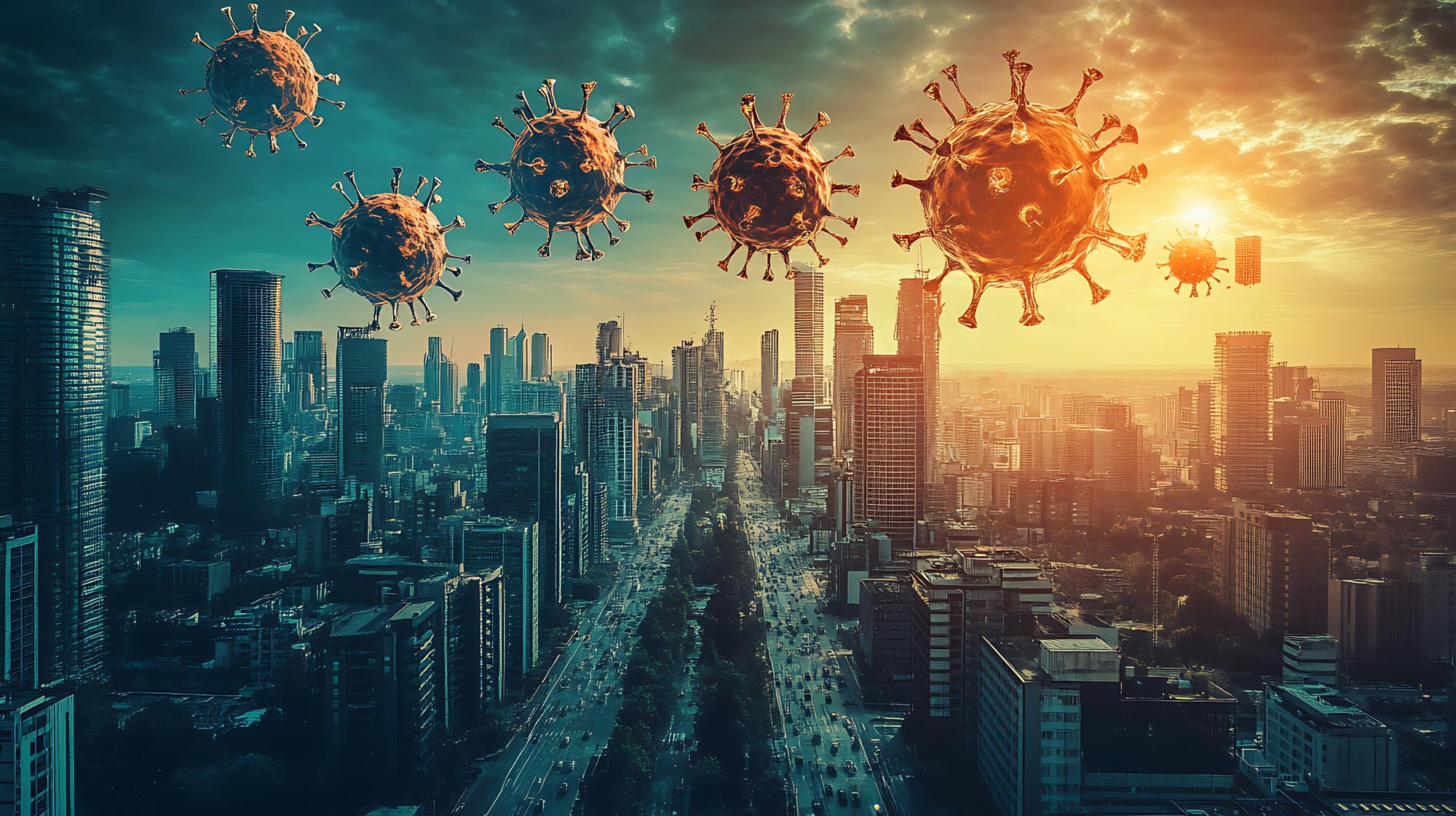
A pandemic is an epidemic of infectious disease that spreads across a large region or the entire world. The word describes scale and geography, not severity: a pandemic can range from moderately disruptive to catastrophic depending on how transmissible and lethal the pathogen is, how quickly health systems respond, and whether effective countermeasures exist. Understanding the pathway from initial outbreak to declared pandemic helps explain why early detection matters so much, and why the global surveillance systems built to catch that early signal are among the most important shared infrastructure the world has.
The stages of spread
Infectious disease outbreaks typically begin with a cluster of cases in a single location. If the pathogen spreads efficiently from person to person, and if it is not contained quickly, the cluster grows into a local epidemic. Whether it goes further depends on several factors: how easily it transmits, how long infected people are contagious before they feel ill (the incubation period), how much people travel in and out of the affected area, and whether the population has any prior immunity. A pathogen that spreads before symptoms appear is particularly difficult to contain, because infected people are travelling and interacting normally while unknowingly passing it on. Modern global travel means that a new pathogen can reach most major cities within days of the initial cluster.
How the world watches
The World Health Organization is the primary international body for disease surveillance and coordination. Member states are required under the International Health Regulations to notify the WHO of events that could constitute a Public Health Emergency of International Concern, the formal declaration that triggers coordinated global response. Beyond formal reporting, the WHO and partner agencies monitor news sources, hospital admission patterns, social media signals, and laboratory reports for early warning. A network of national public health agencies, including those in Australia, the United States, the United Kingdom, and the European Union, shares data and coordinates response through established channels. Genomic sequencing, which became central during recent outbreaks, allows scientists to identify and track the spread of specific variants in near real time.
The gaps that remain
The system has significant weaknesses. Reporting depends on countries being willing and able to notify promptly, and the incentives to delay notification can be strong: a report of a new disease can trigger travel restrictions and economic disruption. Laboratory capacity is unevenly distributed: many low-income countries lack the infrastructure to identify a new pathogen quickly. Zoonotic spillover, the jump of a pathogen from animals to humans, is an inherent risk of the relationship between expanding human populations and wildlife habitats, and monitoring animal health as well as human health requires resources and coordination that are not yet universal.
What it means for Australia
Australia's geography provides some buffer: being an island continent with managed borders means that border biosecurity is a genuine tool. The Australian Centre for Disease Control, established following reviews of pandemic response, is building the national surveillance and coordination capacity that previous arrangements lacked. Australia also contributes to global health security through the WHO, through bilateral health partnerships in the Indo-Pacific, and through investment in vaccine and diagnostics manufacturing capacity. The proximity of Australia to Southeast Asia and the Pacific, regions with dense human-animal interfaces, means that early detection in those regions directly protects Australian public health.
The bottom line
Pandemics are not random: they follow from predictable interactions between pathogens, human populations, and the gaps in the systems designed to catch them early. The investment required to close those gaps is large, but substantially smaller than the cost of the crises that result when they fail.
This article was compiled by AI and screened before publishing. See our editorial standards.
Sources Include (But not Limited to)
Source material used in preparing this article is listed below so readers can check the original record.